Itinerary Overview
Santa Cruz de Tenerife/Seville (Cadiz)
Route Map
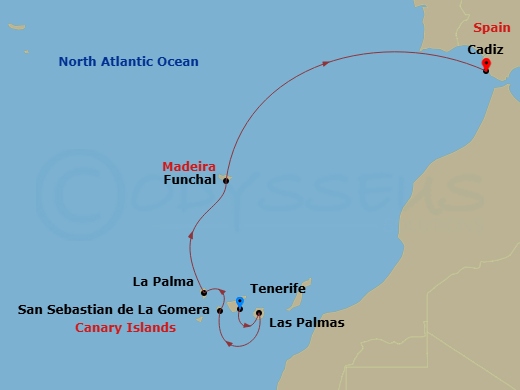
Daily Itinerary
Day 1 Jan 26, 2027 - Santa Cruz de Tenerife
The Canary Archipelago, or Fortunate Islands, as they are often called, owe their fame and fortune to their geographical location and climate. Of volcanic origin, the islands lie off the African coast and encompass such a variety of features that in the course of a day it is possible to pick bananas, throw snowballs, swim in the Atlantic and climb mountains. Tenerife is the largest of Canaries. The south features a desert with grotesque rock formations and chunks of cooled lava. Further north stretch miles of green fields of bananas, tomatoes and potatoes. Mountain slopes are dotted with beech, eucalyptus and pine trees. The coastline is as varied as the areas inland, offering black, grey and golden sand, cliffs, tame beaches and wild capes. A spectacular example of past volcanic activity is Canadas crater which rings Mount Teide - the main feature of the island. At 12,198 feet, the cone-shaped Teide is the highest Spanish summit and nearly always snow-capped. A cable car is available to the top.
Day 2 Jan 27, 2027 - Las Palmas (Gran Canaria)
Also known as Grand Canary, Las Palmas in the largest of Spain’s Canary Islands. During Christopher Columbus’ 1492 voyage of discovery, he was forced to pull his ships into Grand Canary to make repairs to the “Pinta”. During three subsequent voyages, he stopped again in the Canary Islands on his voyage of discovery. During the late fifteenth century, the city of Las Palmas was established by the Spanish in the heart of a lush palm grove. It is today the largest city in the archipelago as well as one of Spain’s leading ports.
Day 3 Jan 28, 2027 - Las Palmas (Gran Canaria)
Also known as Grand Canary, Las Palmas in the largest of Spain’s Canary Islands. During Christopher Columbus’ 1492 voyage of discovery, he was forced to pull his ships into Grand Canary to make repairs to the “Pinta”. During three subsequent voyages, he stopped again in the Canary Islands on his voyage of discovery. During the late fifteenth century, the city of Las Palmas was established by the Spanish in the heart of a lush palm grove. It is today the largest city in the archipelago as well as one of Spain’s leading ports.
Day 4 Jan 29, 2027 - San Sebastian (Spain)
Day 5 Jan 30, 2027 - Santa Cruz de La Palma
The Canary Islands encompass such a variety of features that in the course of a day it is possible to pick bananas, throw snowballs, swim in the Atlantic and climb mountains. La Palma is the most western of the Canary Islands — and probably the greenest. Over seventy percent of the island is a natural preserve. La Palma has an abundance of wild plants and wild flowers, many of which only occur on La Palma, or only on the Canary islands.. For the adventurous, there are national parks with miles and miles of hiking trails to explore. Hike along the coast, through forests and up mountain peaks of up to 8,000 feet. There are also extinct and active volcanoes to hike around as well. Santa Cruz, the main port and capital of the island, is a charming Spanish town complete with a 17th century castle, a Renaissance church and an exquisite 16th century town hall. Here one can also find a mock-up of Columbus's ship The Santa Maria near the northern end of the boulevard by the maritime museum.
Day 6 Jan 31, 2027 - At Sea
Day 7 Feb 01, 2027 - Funchal (Madeira), Portugal
Madeira has been described as "Island of Eternal Spring". It is renowned for its wine, which many feel ranks among the world’s best. Funchal has a wide selection of resort hotels where watersports, golf and tennis are popular. Visitors can tour the 15th-century cathedral, orchid gardens of Quinta das Cruzes, and buildings associated with Christopher Columbus. Madeira’s discoverer, Zarco, is believed to have lived in the house Quinta das Cruzes. Now it displays furniture and paintings and is surrounded by fabulous gardens. The stunning 15th-century design of Sé Cathedral features white stucco with contrasting black basalt and red tufa rock; the ceiling is inlaid with ivory. Located near Town Hall, the Museum of Sacred Art contains art from several islands, including a group of 15th- and 16th-century paintings of Portuguese and Flemish schools. Visit colorful Mercado dos Lavradores during the morning to see flower vendors and fish and produce stands.
Day 8 Feb 02, 2027 - At Sea
Day 9 Feb 03, 2027 - At Sea
Day 10 Feb 04, 2027 - At Sea
Day 11 Feb 05, 2027 - Seville (Cadiz)
Cadiz is an old city with Andalusian character. The magnificent Baroque cathedral and impressive mansions were built with gold. Cadiz’s modern-day treasure lies 30 minutes to the north in the rolling hills of Jerez - where production of the liquid gold, as the famous sherry is often called, ensures a booming economy. Visit one of the bodegas for a tour and tasting. The Historic City Center of Old Cadiz is a pedestrian zone for a pleasant stroll. The monument to "Las Cortes" is the Spanish Parliament established in Plaza de España. The 18th-century golden-domed Cathedral of Santa Cruz looms over the whitewashed houses. The dazzling interior contains a magnificent collection of sculptures and art objects. The Museum of History features an outstanding model of Cadiz in ivory and mahogany that illustrates what the town looked like at the end of the 18th century. The small, colorful Flower Market offers much local flavor. The Moorish-style Alameda Apodaca Gardens serve as a reminder of the Moors’ occupation in past centuries.
Stateroom Categories


Included Inclusions & Amenities
- 10-night Cruise
- Meals
- Entertainment
Trip Summary
Pricing Terms & Remarks
Prices are per person, based on double occupancy and include government fees and taxes. Optional airfare and transfers additional.
All fares are quoted in US Dollars.
