Itinerary Overview
Kyoto (Kobe)/Yokohama (Tokyo)
Route Map
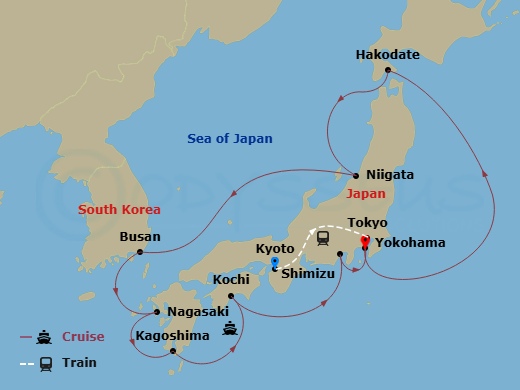
Daily Itinerary
Day 1 Aug 31, 2026 - Kyoto (Kobe)
Kobe, located in Japan, is capital of Hyogo Prefecture, southwestern Honshu Island, on Osaka Bay, near the city of Osaka. Since the 1890s several adjoining cities, including Hyogo, have been absorbed by Kobe. Behind the narrow coastal site of the city are mountains on which suburban residences and hotels have been built. Many Christian churches, Shinto and Buddhist temples and shrines, two famous statues of Buddha, a fine arts museum, and a municipal museum with a collection on Western cultural contact are in Kobe. From here you can also visit Kyoto, Nara and Sorakuen Garden.
Day 2 Sep 01, 2026 - Kyoto (Kobe)
Kobe, located in Japan, is capital of Hyogo Prefecture, southwestern Honshu Island, on Osaka Bay, near the city of Osaka. Since the 1890s several adjoining cities, including Hyogo, have been absorbed by Kobe. Behind the narrow coastal site of the city are mountains on which suburban residences and hotels have been built. Many Christian churches, Shinto and Buddhist temples and shrines, two famous statues of Buddha, a fine arts museum, and a municipal museum with a collection on Western cultural contact are in Kobe. From here you can also visit Kyoto, Nara and Sorakuen Garden.
Day 3 Sep 02, 2026 - Tokyo
Tokyo, Japan, presents a different view at every turn. It's one of the world's main economic centers and its most populous agglomeration. The business of Tokyo is business, but you can still find harmony and small-scale gardens on back streets. Around the corner from neon and concrete, you may find the bonsai-lined courtyard of a traditional inn.
Tokyo was nearly destroyed by bombs and fires during World War II, and by earthquakes at other times, but it has always rebuilt itself. As a result, there is little left of Old Japan in the city, but there's plenty of New Japan to take its place.
The streets are a confusing maze, so a map is essential. The transit system is excellent, however, and there are kobans (police boxes) throughout the metropolis, as well as a populace generally willing to answer questions.
Visitors to Tokyo represent both business and leisure travelers. And despite its past reputation, Tokyo is no longer fearsomely expensive. It's relatively easy to visit Tokyo on a budget.
Day 4 Sep 03, 2026 - Tokyo
Tokyo, Japan, presents a different view at every turn. It's one of the world's main economic centers and its most populous agglomeration. The business of Tokyo is business, but you can still find harmony and small-scale gardens on back streets. Around the corner from neon and concrete, you may find the bonsai-lined courtyard of a traditional inn.
Tokyo was nearly destroyed by bombs and fires during World War II, and by earthquakes at other times, but it has always rebuilt itself. As a result, there is little left of Old Japan in the city, but there's plenty of New Japan to take its place.
The streets are a confusing maze, so a map is essential. The transit system is excellent, however, and there are kobans (police boxes) throughout the metropolis, as well as a populace generally willing to answer questions.
Visitors to Tokyo represent both business and leisure travelers. And despite its past reputation, Tokyo is no longer fearsomely expensive. It's relatively easy to visit Tokyo on a budget.
Day 5 Sep 04, 2026 - Tokyo
Tokyo, Japan, presents a different view at every turn. It's one of the world's main economic centers and its most populous agglomeration. The business of Tokyo is business, but you can still find harmony and small-scale gardens on back streets. Around the corner from neon and concrete, you may find the bonsai-lined courtyard of a traditional inn.
Tokyo was nearly destroyed by bombs and fires during World War II, and by earthquakes at other times, but it has always rebuilt itself. As a result, there is little left of Old Japan in the city, but there's plenty of New Japan to take its place.
The streets are a confusing maze, so a map is essential. The transit system is excellent, however, and there are kobans (police boxes) throughout the metropolis, as well as a populace generally willing to answer questions.
Visitors to Tokyo represent both business and leisure travelers. And despite its past reputation, Tokyo is no longer fearsomely expensive. It's relatively easy to visit Tokyo on a budget.
Day 6 Sep 05, 2026 - Yokohama (Tokyo)
Yokohama is located on the southern part of Honshu Island, on the western shore of Tokyo Bay, and is our gateway to Tokyo. It has excellent harbour facilities and is one of the leading ports industrial centres of Japan. There are numerous shrines, temples, and Christian churches and a number of beautiful parks. A small fishing village in 1854, Yokohama was almost totally destroyed in 1923 by an earthquake. Gradually reconstructed the city is now among the most modern in Japan. It was heavily bombed in 1945, during World War II.
Day 7 Sep 05, 2026 - Yokohama (Tokyo)
Yokohama is located on the southern part of Honshu Island, on the western shore of Tokyo Bay, and is our gateway to Tokyo. It has excellent harbour facilities and is one of the leading ports industrial centres of Japan. There are numerous shrines, temples, and Christian churches and a number of beautiful parks. A small fishing village in 1854, Yokohama was almost totally destroyed in 1923 by an earthquake. Gradually reconstructed the city is now among the most modern in Japan. It was heavily bombed in 1945, during World War II.
Day 8 Sep 06, 2026 - At Sea
Day 9 Sep 07, 2026 - Hakodate
The fan shaped city Hakodate was once an island but now straddles a sandbar linking it to the mainland. Sites worth visiting include Mount Hakodate (cable car), the Old Public Hall, the Russian Orthodox Church and Goryokaku Fort. Nearby is the Onuma Quasi-National Park and Mount Komagatake.
Day 10 Sep 08, 2026 - Niigata
Niigata has a long history as a port and is distinguished for being the site of one of only five international ports opened in 1868 when Japan resumed contact with other countries after nearly 250 years of self-imposed isolation. Since that time, Niigata has developed into one of Japan's most important modern international ports. Geographically, the city is distinctive in that it is surrounded by water. The Shinano and Agano, two of the largest rivers in Japan, run through the heart of Niigata before emptying into the Japan Sea. In addition, until relatively recently, the city was crisscrossed by a series of canals used to transport goods. Although the canals have been filled in to make the construction of modern roadways possible, the willows that lined these canals still remain today and now serve to lend a gentle air to the bustling downtown area. Although Niigata has grown into an important regional center of activity, the city has pursued a plan of careful development in order to preserve its traditional culture, natural environment, and distinctive local character. When Niigata is mentioned, many people often think immediately of the area's delicious rice and sake or the city's beautiful sunsets, but the residents of Niigata themselves take pride, rather, in the spirit of hospitality and community that so distinguishes the city. Following this tradition, the city's long held goal has been to create a society where every citizen is valued and allowed to shine. Numerous cultural and civic facilities support the activities of local groups and organizations. In addition, Niigata's conscientious system of social welfare seeks to preserve the dignity as well as the well-being of all of the city's residents. The city is constantly trying to tackle society's problems in progressive, innovative and caring ways.
Day 11 Sep 09, 2026 - At Sea
Day 12 Sep 10, 2026 - Pusan (Busan)
Korea's "museum without walls" is akin only to China in its depth and cultural wonder. From Pusan, you can journey to the ancient Silla capital of Kyongju, a dynasty which reigned in Korea for almost a thousand years. Today this small provincial town is virtually a museum without walls, dotted with many splendid ruins. Nearby, the forested mountains and valleys shelter hundreds of beautiful Buddhist shrines including the renowned Sokkuram Grotto, and Tongdosa and Pulguksa Temples. Pusan is also a shopper's mecca and Korea's vital southern link to Japanese and American trade.
Day 13 Sep 11, 2026 - Nagasaki
One of Japan's most historic cities, Nagasaki was a major port, trading with the Portuguese and Dutch in the 16th century. You can still see this colonial legacy in the brick buildings, old forts, canals and curving cobblestone streets. On a hill overlooking the bay, beautiful Glover Mansion, the setting of Madame Butterfly, is typical of the fine homes built by wealthy foreign residents. But Nagasaki's ties with Korea and China are equally apparent in the famous Chinese temple, a large Chinese colony and the numerous fine Korean and Chinese restaurants.
Day 14 Sep 12, 2026 - Kagoshima
Kagoshima, a seaport on Kyushu Island, Japan, is sheltered within Kagoshima Bay and is the commercial and cultural center of southern Kyushu. Products manufactured here include a famous type of earthenware known as Satsumaware. Sights of interest include the Iso Garden and the local Theatre.
Day 15 Sep 13, 2026 - Kochi
Kochi has beautiful lagoons and lakes and offers travelers an extraordinary setting for a stay of a few nights.
Day 16 Sep 14, 2026 - Shimizu
Shimizu is located on the northwest coast of Suruga Bay on the island of Honshu. Protected by a sandspit, it is a major commercial port and fishing centre. Places of scenic and historic interest include the Pine Groves of Miho, the Ryuge Temple, containing a fern palm believed to be more than 1,000 years old, and the nearby Nippon-Daira plateau.
Day 17 Sep 15, 2026 - Yokohama (Tokyo)
Yokohama is located on the southern part of Honshu Island, on the western shore of Tokyo Bay, and is our gateway to Tokyo. It has excellent harbour facilities and is one of the leading ports industrial centres of Japan. There are numerous shrines, temples, and Christian churches and a number of beautiful parks. A small fishing village in 1854, Yokohama was almost totally destroyed in 1923 by an earthquake. Gradually reconstructed the city is now among the most modern in Japan. It was heavily bombed in 1945, during World War II.
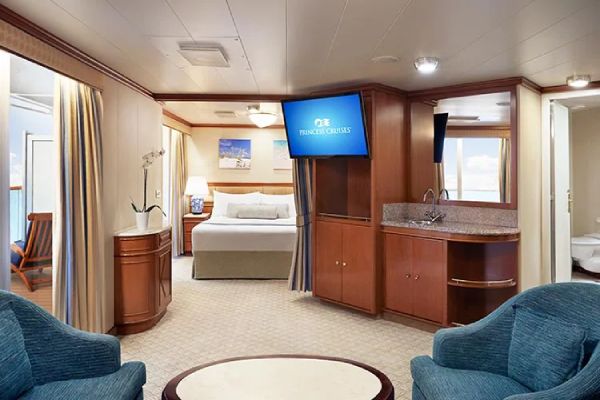
Stateroom Categories




Included Inclusions & Amenities
- 10-night Cruise, Meals and Entertainment
- 5-night/6-day Land Tour
Trip Summary
Pricing Terms & Remarks
Prices are per person, based on double occupancy and include Taxes, Fees and Port Expenses. Optional airfare and transfers additional.
See applicable Princess® brochure for terms, conditions and definitions that will apply to your booking.
Fares listed may require a non-refundable deposit at time of booking. Higher fares, not requiring a non-refundable deposit at time of booking, may be available. Please contact your travel consultant for more information.
All fares are quoted in US Dollars.
