Itinerary Overview
Athens (Piraeus)/Rome (Civitavecchia)
Route Map
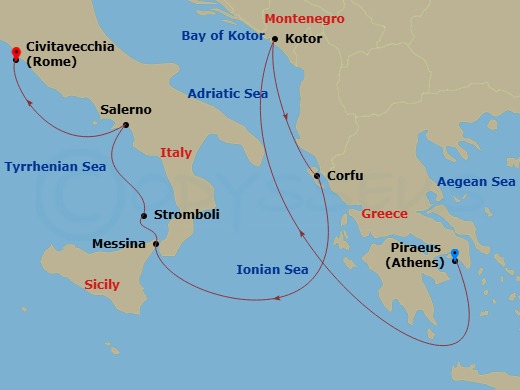
Daily Itinerary
Day 1 Aug 22, 2026 - Athens (Piraeus)
Piraeus is the seaport for Athens, the capital of western civilization, which boasts a fantastic mix of classical ruins and vivacious modern life. Climb the hill of Acropolis to wonder at the Parthenon, join the lively Athenians in Constitution Square, and find a welcoming taverna for spirited bizouki music, plenty of ouzo to drink, and energetic Greek dancing. Piraeus is the largest harbor in the country. The white chapel of St. George at its summit has a theater bearing the same name. The hill of Nymphs is the site of a planetarium, which is located above magnificent Thesseio temple. Among all of these hills, Acropolis is the one that glorified Athens and the whole Greek world and became the symbol of the western civilization. Bays and small rocky or sandy coves dot the area and during the summer are filled with Athenians and foreigners enjoying their beauty.
Day 2 Aug 23, 2026 - At Sea
Day 3 Aug 24, 2026 - Kotor
Take a step back in time and visit the old town of Kotor, one of the best-preserved medieval towns in this part of the Mediterranean. The asymmetric structure of the narrow streets and squares, combined with the awesome monuments of medieval architecture, contributed to Kotor being placed on UNESCO’s “World’s natural and cultural inheritance” list. From ancient fortification systems surrounding the city to 12th century cathedrals, Kotor is a dream come true for those who revel in history. Entrance to town from the Gurdic spring, consists of 3 separate gates, built from the 13th, 16th and 18th centuries. The Cathedral of St. Tryphon is one of the most visited and impressive churches in the city. According to some texts, the original church was erected in the 8th century and rebuilt in 1166. Two earthquakes, one in 1667 and one in 1979 seriously damaged the cathedral and it continues to be restored to this day. The city is breathtaking in every respect and only a visit will truly reveal all it has to offer.
Day 4 Aug 24, 2026 - Bay of Kotor
For centuries, Montenegro's Boka Kotorska, or Bay of Kotor, the deepest coastal inlet in the Mediterranean, was the boundary between Christianity and Islam. Today, the beach-lined bay, located 35 mi/55 km west of Podgorica, is home to several tourist resorts and historical sites. It is also considered one of the most beautiful bays in the world, and is the southernmost fjord in Europe.
Herceg Novi, strategically located at the northern entrance of the Bay of Kotor, is close to the borders of Bosnia and Croatia. Herceg Novi is noted for its city gates, fortresses and the church and monastery of Savina, which contain Gothic and baroque architecture. It is also a haven for artists, with numerous galleries located throughout the area that continuously hold exhibitions. If you visit in February, you can attend the Mimosa Festival, which is the city's oldest traditional event.
The 14th-century port of Perast has been declared a national conservation area. It has a strong seafaring tradition—Peter the Great, when building up the Russian Navy, sent sailors to its naval academy. With the mountains in the background and the Bay of Kotor in the foreground, Perast is a pleasant place to spend some time just relaxing or strolling its narrow streets.
At the southern end of the bay is the town of Kotor, a medieval walled city on the UNESCO World Heritage list. Kotor rates a full day to walk its narrow streets, investigate the shops and see Katedrala Sv. Tripuna (St. Tryphon's Cathedral). History buffs will enjoy the Maritime Museum located in the Grgurina Palace. If you're feeling fit, you can walk on Kotor's fortress walls that eventually wind their way up to St. Ivan's Castle. It's a steep climb, but worth it for the views of the bay.
Other interesting places along the bay include the fortresses and second-century Roman mosaics in Risan and the Island of Flowers near Tivat.
Day 5 Aug 25, 2026 - Corfu
Corfu's unique scenery, with gentle green hills and luxuriant southern flora, makes it one of the most beautiful of all Greek islands. Many beautiful buildings can be seen in Corfu Town. Corfu is a popular holiday destination for vacationers from all walks of life who come to enjoy mild climate, calm blue-green water, rugged mountains, hidden coves and miles of sandy beaches. A number of historical sights range from old fortresses and mansions to cathedrals and palaces. Corfu Town is surrounded by arcaded Venetian buildings. The Spianada is considered to be the largest square in Greece. Explore the narrow streets of Old Town. See Town Hall and the 300-year-old Church of Saint Spyrídon; a silver sarcophagus contains the remains of the town's patron saint. The Royal Palace - a neo-classical mansion - holds on its upper floor the Museum of Byzantine and East Asian Art. The Archaeological Museum has displays of artifacts discovered on Corfu. The Old Fortress, an impressive 14th-century Venetian structure, is now used as a popular venue for concerts.
Day 6 Aug 26, 2026 - Messina, Sicily
Situated on the western shore of the Strait bearing its name, the port at the entrance to Sicily is one of the deepest and safest in the Mediterranean. The city's was rebuilt low buildings to minimize the danger of earthquakes. This gives the center a pleasant, open townscape combining sea, sky and hills. Train-ferries, car-ferries and hydrofoils make the connection across the Strait of Messina to Reggio Calabria on the Italian mainland. Among the main attractions is the Norman-Romanesque cathedral, with an adjoining bell tower. The works of Renaissance painter Antonello da Messina and two large Caravaggios can be seen at the Museo Regionale - which features an interesting collection of material salvaged after the 1908 earthquake. From Messina, excursions are possible to Taormina, Mount Etna and across the Strait to mainland Italy.
Day 7 Aug 26, 2026 - Strait of Messina
Channel in the Mediterranean Sea separating Sicily in the west and Italy in the east and linking the Tyrrhenian and Ionian seas. The strait is 20 miles long, 2 miles wide in the north (between Faro Point and the Rock of Scylla), and 10 miles wide in the south (between capes Alì and Pellaro); it is 300 feet deep at the northern end.
Day 8 Aug 26, 2026 - Stromboli
Stromboli is a volcanic island located just north of Sicily in Italy. It is home to one of the most active volcanoes on Earth, with its continuous eruptions in the past 2000 years. The island itself is 2 miles in diameter and about 3000 feet above sea level.
Day 9 Aug 27, 2026 - Salerno
Salerno is situated at the northern end of the Gulf of Salerno. The old town, rising up the slopes of the hill on the site of ancient Salernum, still bears evidence of its medieval period. Salerno's main attraction is a Romanesque cathedral, built in 1085 and remodeled in the late 18th century. Inside is the ornate tomb of Margaret of Anjou and the tomb of Pope Gregory VII, who died here in 1085. In the richly decorated crypt under the alter lie the remains of Evangelist Matthew, brought here from Paestum. A hilltop crowned by the old Lombard Castello offers extensive views. Along the seafront, to the east of the harbor, extends a promenade lined with impressive modern buildings. Visit the Greek temples of Paestum. Other favorite excursions from here are to Pompeii and to the popular resort towns of Amalfi and Ravello. The Museo Diocesano houses a fine collection of medieval carved tablets. Occupying two floors of the San Benedetto Monastery, the main attraction at Museo Provinciale is a handsome bronze head of Apollo fished out of the bay in the 1930s.
Day 10 Aug 28, 2026 - Salerno
Salerno is situated at the northern end of the Gulf of Salerno. The old town, rising up the slopes of the hill on the site of ancient Salernum, still bears evidence of its medieval period. Salerno's main attraction is a Romanesque cathedral, built in 1085 and remodeled in the late 18th century. Inside is the ornate tomb of Margaret of Anjou and the tomb of Pope Gregory VII, who died here in 1085. In the richly decorated crypt under the alter lie the remains of Evangelist Matthew, brought here from Paestum. A hilltop crowned by the old Lombard Castello offers extensive views. Along the seafront, to the east of the harbor, extends a promenade lined with impressive modern buildings. Visit the Greek temples of Paestum. Other favorite excursions from here are to Pompeii and to the popular resort towns of Amalfi and Ravello. The Museo Diocesano houses a fine collection of medieval carved tablets. Occupying two floors of the San Benedetto Monastery, the main attraction at Museo Provinciale is a handsome bronze head of Apollo fished out of the bay in the 1930s.
Day 11 Aug 29, 2026 - Rome (Civitavecchia)
Civitavecchia is the port city for Rome. Rome has always been and remains the Eternal City. With its splendid churches, ancient monuments and palaces, spacious parks, tree-lined boulevards, fountains, outdoor cafés and elegant shops, Rome is one of the world’s most attractive cities. Among the most famous monuments is the Colosseum where spectators watched combats between muscled gladiators and ferocious animals. Stop to see the remains of the Forum, once a political and commercial center. Rome’s squares were enhanced with such imposing structures as the Vittorio Emanuele Monument and grandiose fountains like the Fontana di Trevi. Awe at Christendom’s most magnificent church, the Sistine Chapel. The busy square Piazza Venezia is easily recognized by its imposing Vittorio Emanuele II Monument. Take a stroll to Rome's famous Trevi Fountain. Vatican City is the site of lovely St. Peter's Square and St. Peter's Basilica, where for 200 years, Renaissance masters worked on its design and created an unparalleled masterpiece. Visit Vatican Museum.
Stateroom Categories


Included Inclusions & Amenities
- 7-night Cruise
- Meals
- Entertainment
