Itinerary Overview
Barcelona/Santa Cruz de Tenerife
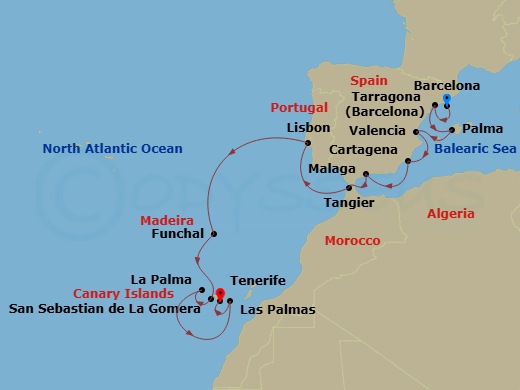
Route Map
Daily Itinerary
Day 1 Oct 30, 2026 - Barcelona
Barcelona, the self-confident and progressive capital of Spain, is a tremendous place to be. Though it boasts outstanding Gothic and Art Nouveau buildings, and some great museums – most notably those dedicated to Picasso and Catalan art – it is above all a place where there's enjoyment simply in walking the streets, stopping in at bars and cafés, drinking in the atmosphere. A thriving port and the most prosperous commercial centre in Spain, it has a sophistication and cultural dynamism way ahead of the rest of the country. In part this reflects the city's proximity to France, whose influence is apparent in the elegant boulevards and imaginative cooking. But Barcelona has also evolved an individual and eclectic cultural identity, most perfectly and eccentrically expressed in the architecture of Antoni Gaudí. Scattered as Barcelona's main sights may be, the greatest concentration of interest is around the old town (La Ciutat Vella). These cramped streets above the harbor are easily manageable, and far more enjoyable, on foot. Start, as everyone else does, with the Ramblas.
Day 2 Oct 31, 2026 - Barcelona (Tarragona)
Tarragona is a port on the Mediterranean Sea on the Catalonian coast to the southwest of Barcelona. The monks of the Grande Chartreuse established their liqueur distillery here in 1903, when they were forced to leave France. The city's archaeological museum has an outstanding collection of Roman statuary. The remains of a Roman amphitheatre and defensive walls are in the city, and a two-tiered Roman aqueduct is nearby. The Romanesque cathedral, construction of which was begun in the 12th century, is famous for its Gothic facade. Nearby are the beaches and resorts of the Costa Dorado.
Day 3 Nov 01, 2026 - Palma de Mallorca
The Balearics are comprised of 16 islands; the three principal ones are Mallorca, Ibiza and Menorca. Lying just 60 miles off the Spanish mainland, the islands’ lush and rugged landscape combined with an extremely mild, sunny climate prove irresistible. The Balearics boast cosmopolitan resorts with lively nightlife and plenty of sports activities. Palma de Majorca is the capital of the archipelago. A cosmopolitan city with sophisticated shops and restaurants, it also offers buildings of spectacular Moorish and gothic architecture. Museo de Mallorca housed in the Palacio Ayamans boasts an interesting collection of Moorish, medieval and 18th- to 19th-century art. Those who wish to explore the northern end of the island will enjoy the dramatic land and seascape of Cabo Formentor at the end of a long, narrow peninsula. A winding road with magnificent views leads to the luxury Hotel Formentor, beautifully situated above the bay. The lighthouse of Cabo Formentor is the most northerly point on Majorca.
Day 4 Nov 02, 2026 - Valencia
Valencia is one of the biggest, liveliest cities in Spain. It is located at the Mediterranean sea with beaches right in its heart that offer every kind of sports. With its active nightlife and various cultural offerings, Valencia is one of the most dynamic cities in Spain. One of the most famous buildings in Valencia is the Cathedral and its tower named, "El Miquelet" (Little Michael) which was built between 1381 and 1424. Try Spain's most famous food right where it was born: "Paella Valenciana". Valencia is the city where "El Cid", Spain's national hero, fought against the Moors, and popular festivals in the city and many villages around still remind of this epoch.
Day 5 Nov 03, 2026 - Cartagena (Spain)
Today Spain's major commercial port and naval base, Cartagena lies on the coast of Murcia, its great indented bay guarded by rocky promontories, each topped by a fort. The city contains the remains of old walls, a castle constructed probably in Carthaginian times, and a church that was formerly a 13th-century cathedral. Attractive promenades extend along the harbour, while to the northeast is the famous beach and watersports resort area of the lagoon-like Mar Menor.
Day 6 Nov 04, 2026 - At Sea
Day 7 Nov 05, 2026 - Malaga
Malaga is a popular holiday destination - known as the birthplace of Picasso and for sweet Malaga dessert wines from vineyards outside of town. Points of interest include impressive Gothic architecture, remains of a Moorish castle and interesting museums. Malaga is a popular starting point for trips to Granada and resorts along Costa del Sol. Splendid Granada and famed Alhambra are the region’s most outstanding attractions. Magnificent Moorish palaces and fortifications contrast sharply with Christian churches from Spain’s 1492 Reconquest era. Ronda's incredible location affording spectacular views over the valley and distant hills. Malaga Fine Arts Museum holds works by Spanish artists of the 16th to 20th centuries and by artists from Malaga, including Picasso. Marbella, which has been favored by the rich and famous, is a very popular holiday and yachting resort destination. One of the first resorts of the Costa del Sol, Torremolinos has luxury hotels, busy plazas and shopping streets, a lively art scene, a Wax Museum created by Madame Tussaud, and a glitzy casino.
Day 8 Nov 06, 2026 - Malaga
Malaga is a popular holiday destination - known as the birthplace of Picasso and for sweet Malaga dessert wines from vineyards outside of town. Points of interest include impressive Gothic architecture, remains of a Moorish castle and interesting museums. Malaga is a popular starting point for trips to Granada and resorts along Costa del Sol. Splendid Granada and famed Alhambra are the region’s most outstanding attractions. Magnificent Moorish palaces and fortifications contrast sharply with Christian churches from Spain’s 1492 Reconquest era. Ronda's incredible location affording spectacular views over the valley and distant hills. Malaga Fine Arts Museum holds works by Spanish artists of the 16th to 20th centuries and by artists from Malaga, including Picasso. Marbella, which has been favored by the rich and famous, is a very popular holiday and yachting resort destination. One of the first resorts of the Costa del Sol, Torremolinos has luxury hotels, busy plazas and shopping streets, a lively art scene, a Wax Museum created by Madame Tussaud, and a glitzy casino.
Day 9 Nov 07, 2026 - Tangier
The "Gateway to Africa," located at its northwestern tip, Tangier is a fashionable resort retaining its age-old mystery and excitement. French and Islamic influences meet and merge in this fascinating old city. Mosques and minarets overlook the shadowy streets of the bazaar, while the higher part of town, with its broad boulevards and lovely parks, looks down on the ocean.
Day 10 Nov 08, 2026 - At Sea
Day 11 Nov 09, 2026 - Lisbon
Portugal’s capital is an 18th-century city - elegant, open to the sea and carefully planned. Most places of interest are within easy walking distance. Rossio Square, the heart of Lisbon since medieval times, is an ideal place to start exploring. Many rebuilt houses with original façades provide stores and restaurants with modern interiors. High above Baixa is Bairro Alto - with its teeming nightlife. There are many monuments and museums, such as San Jeronimos Monastery, Royal Coach Museum and Gulbenkian Museum. Two well-known landmarks are the Monument to the Discoveries and the Tower of Belem. A statue of Christ looms above Europe’s longest suspension bridge. Madragoa, Bica and Bairro Alto, Lisbon’s older sections, offer a variety of sights: the Church of Sao Roque, with its beautiful tiles; St. George Castle, which offers a splendid view from its location above the Alfama quarter; the botanical gardens, featuring an unusual, cold greenhouse; and the cathedral, stunning with its Moorish design. Renowned Gulbenkian Museum is the cultural center of Portugal.
Day 12 Nov 10, 2026 - At Sea
Day 13 Nov 11, 2026 - At Sea
Day 14 Nov 12, 2026 - Funchal (Madeira), Portugal
Madeira has been described as "Island of Eternal Spring". It is renowned for its wine, which many feel ranks among the world’s best. Funchal has a wide selection of resort hotels where watersports, golf and tennis are popular. Visitors can tour the 15th-century cathedral, orchid gardens of Quinta das Cruzes, and buildings associated with Christopher Columbus. Madeira’s discoverer, Zarco, is believed to have lived in the house Quinta das Cruzes. Now it displays furniture and paintings and is surrounded by fabulous gardens. The stunning 15th-century design of Sé Cathedral features white stucco with contrasting black basalt and red tufa rock; the ceiling is inlaid with ivory. Located near Town Hall, the Museum of Sacred Art contains art from several islands, including a group of 15th- and 16th-century paintings of Portuguese and Flemish schools. Visit colorful Mercado dos Lavradores during the morning to see flower vendors and fish and produce stands.
Day 15 Nov 13, 2026 - At Sea
Day 16 Nov 14, 2026 - San Sebastian (Spain)
Day 17 Nov 15, 2026 - Santa Cruz de La Palma
The Canary Islands encompass such a variety of features that in the course of a day it is possible to pick bananas, throw snowballs, swim in the Atlantic and climb mountains. La Palma is the most western of the Canary Islands — and probably the greenest. Over seventy percent of the island is a natural preserve. La Palma has an abundance of wild plants and wild flowers, many of which only occur on La Palma, or only on the Canary islands.. For the adventurous, there are national parks with miles and miles of hiking trails to explore. Hike along the coast, through forests and up mountain peaks of up to 8,000 feet. There are also extinct and active volcanoes to hike around as well. Santa Cruz, the main port and capital of the island, is a charming Spanish town complete with a 17th century castle, a Renaissance church and an exquisite 16th century town hall. Here one can also find a mock-up of Columbus's ship The Santa Maria near the northern end of the boulevard by the maritime museum.
Day 18 Nov 16, 2026 - Las Palmas (Gran Canaria)
Also known as Grand Canary, Las Palmas in the largest of Spain’s Canary Islands. During Christopher Columbus’ 1492 voyage of discovery, he was forced to pull his ships into Grand Canary to make repairs to the “Pinta”. During three subsequent voyages, he stopped again in the Canary Islands on his voyage of discovery. During the late fifteenth century, the city of Las Palmas was established by the Spanish in the heart of a lush palm grove. It is today the largest city in the archipelago as well as one of Spain’s leading ports.
Day 19 Nov 17, 2026 - Santa Cruz de Tenerife
The Canary Archipelago, or Fortunate Islands, as they are often called, owe their fame and fortune to their geographical location and climate. Of volcanic origin, the islands lie off the African coast and encompass such a variety of features that in the course of a day it is possible to pick bananas, throw snowballs, swim in the Atlantic and climb mountains. Tenerife is the largest of Canaries. The south features a desert with grotesque rock formations and chunks of cooled lava. Further north stretch miles of green fields of bananas, tomatoes and potatoes. Mountain slopes are dotted with beech, eucalyptus and pine trees. The coastline is as varied as the areas inland, offering black, grey and golden sand, cliffs, tame beaches and wild capes. A spectacular example of past volcanic activity is Canadas crater which rings Mount Teide - the main feature of the island. At 12,198 feet, the cone-shaped Teide is the highest Spanish summit and nearly always snow-capped. A cable car is available to the top.
Stateroom Categories


Included Inclusions & Amenities
- 18-night Cruise
- Meals
- Entertainment
Trip Summary
Pricing Terms & Remarks
Prices are per person, based on double occupancy and include government fees and taxes. Optional airfare and transfers additional.
All fares are quoted in US Dollars.
